
Why cashless matters
Cash lets an adult hand money to a minor and walk away. Card-only payment ties every sale to a payment instrument and a timestamp, gives us a complete transaction record, and leaves nothing in the machine worth breaking in for.
This site contains information about nicotine vapor products. You must be 21 or older to continue.
You must be 21 or older to view this site. Please close this window.
This is a self-declared age check, not identity verification. Our machines verify age by scanning a government-issued ID at the point of sale.
The three things a venue owner needs to understand before saying yes — in order, with nothing buried.
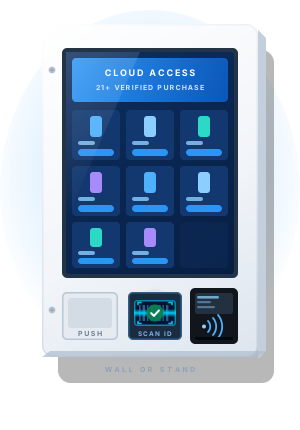
We run the VTM Mini Wall, a compact unit built for age-restricted retail. It's about the size of a large framed picture: two feet wide, under three feet tall, less than nine inches deep. It can hang on a wall and take up no floor at all, or sit on a pedestal stand and take up roughly two square feet — your call, and it can change later if you want to move it.
What sets it apart from an ordinary vending machine is the ID scanner: the machine stays locked until it has read an ID and confirmed the date of birth clears 21. Payment runs through a Nayax card terminal — tap, chip, Apple Pay, Google Pay. No cash.
The age check isn't a checkbox or a question your bartender has to answer. It's a hardware gate between the customer and the product.
The customer presents a government-issued photo ID to the scanner. No selection unlocks and nothing is dispensed before this happens.
The scanner reads the barcode on the back of the ID and checks the date of birth against the 21+ minimum. A damaged, unreadable or under-age ID fails.
Only after a pass does the machine allow a selection and accept payment. A failed check ends the transaction — there's no customer-facing override.
Payment is card or contactless only. The sale is logged electronically; your revenue share is calculated from that log.
Cash lets an adult hand money to a minor and walk away. Card-only payment ties every sale to a payment instrument and a timestamp, gives us a complete transaction record, and leaves nothing in the machine worth breaking in for.
Nothing is kept. VTM, the manufacturer, states the scanner takes no photograph, collects no biometric data, and that no information leaves the machine. It reads the date of birth, decides in about two seconds, and that's it.
To be precise: the scanner confirms the date of birth on a barcode. It does not authenticate the document itself, so it can't tell you an ID is counterfeit or that the holder is its owner. It's a hard gate on age, not a forensic check — and still far more than a keypad asking someone to confirm they're 21.
An ID scanner is a control, not a legal blanket. Under 21 CFR 1140.14(b)(3), a nicotine vending machine is permitted only in a facility where no person under 21 is present or permitted to enter at any time — and the rule contains no exemption for age-verifying technology. FDA guidance is explicit that the facility operator bears responsibility for a machine on their premises even if they don't own it. States may impose stricter requirements on top. A room that is genuinely 21+ is the core fit here. If your venue is 21+ only during certain hours, that isn't an automatic no — the usual route is a permanently access-controlled 21+ area inside the venue, and that's worth a conversation rather than an assumption. We assess each site against the rules that apply before installing, and we would rather lose the placement than misrepresent this. Nothing here is legal advice — talk to us about your venue.
We check the proposed spot — a stretch of wall, or about two square feet of floor — plus a standard outlet, telemetry signal, delivery access, sightlines, and how your entry policy works. Usually a short visit or a few photos.
A one-page placement agreement in plain language: revenue share, term, access hours, responsibilities, removal. You keep a copy. Our permits and licensing are our job.
Scheduled around your hours. We set it up the way you picked — on the wall or on its stand — power it, connect it, load the first fill and test the ID scanner with you watching. Live the same day.
A good placement is one the host stops thinking about. Ours is built to be low-touch on your side.
Every sale is cashless, so the machine records it. Your monthly statement comes from that record: units sold, gross sales, your share.
What sets your share:
We don't publish a fixed percentage because we don't offer everyone the same one. The split is negotiable and set against your site's actual numbers. Ask and we'll give you a range.
Ask before you commit to anything. That's what the form is for.